Do employees need to understand how AI works, or just how to use it responsibly?
Only 24% of employees feel equipped to use AI well, despite 86% using it daily. Here's why closing that gap takes judgment, not more technical training, with 2026 data on what's actually missing.
Only 24% of employees feel fully equipped to use AI well, even though 86% already use it at work, according to Skillsoft’s 2026 Workforce Readiness Report. That 62-point gap points to the real answer underneath the original question: employees don’t need to understand how a model actually works, the math and architecture behind it, but they do need enough of a working model of where AI gets things wrong to catch it before it causes a problem. That’s a narrower, more teachable kind of understanding than most “AI literacy” programs are actually built around.
What "understanding how AI works" should mean for most employees
For almost every role, understanding AI doesn’t mean explaining how a model predicts its next output. It means knowing what kind of tasks it’s reliably good at, where it tends to fail, and why confident-sounding output isn’t the same as correct output. That’s a judgment skill, not a technical one, and it’s teachable in an afternoon in a way that model architecture never will be for a non-technical employee.
This is also where a lot of AI literacy programs quietly overreach. A module that spends an hour explaining transformers and training data before ever mentioning what to actually watch for in a marketing draft or a customer email is optimizing for the wrong kind of comprehension. Employees don’t fail at using AI responsibly because they can’t explain how it was built. They fail because nobody taught them the handful of specific things to check before they hit send.
The confidence gap the 2026 data keeps finding
Skillsoft’s 2026 survey of 2,000 employees, managers, and executives across North America, the UK, and Germany found a 53-point gap between perception and reality:
- 77% of leaders believe their organization has prepared workers to use AI well
- Only 24% of employees agree they’re actually equipped
Separately, TeamViewer’s 2026 global study of 4,200 respondents across nine markets found:
- 75% of employees use AI daily
- 51% say they don’t always know when to trust AI output versus when to verify it
People have adopted the tool faster than they’ve built the judgment to use it well.
Six judgment calls that matter more than technical depth
- Knowing which tasks the tool is weak at, specifically for their own job, not AI in general.
- Recognizing confident-sounding output isn’t the same as correct output. Fluent phrasing is not a quality signal, and for anything that actually matters, the only real test is checking the specific fact or figure against a source.
- Knowing when a task requires mandatory human review before anything goes out the door.
- Understanding what data categories should never go into the tool, a rule, not a technical concept.
- Recognizing the specific ways errors show up in their own domain, a wrong citation, a miscalculated figure, a fabricated detail.
- Knowing who to ask when something looks off, so a judgment call doesn’t dead-end with the employee alone.
Does more technical training close the gap?
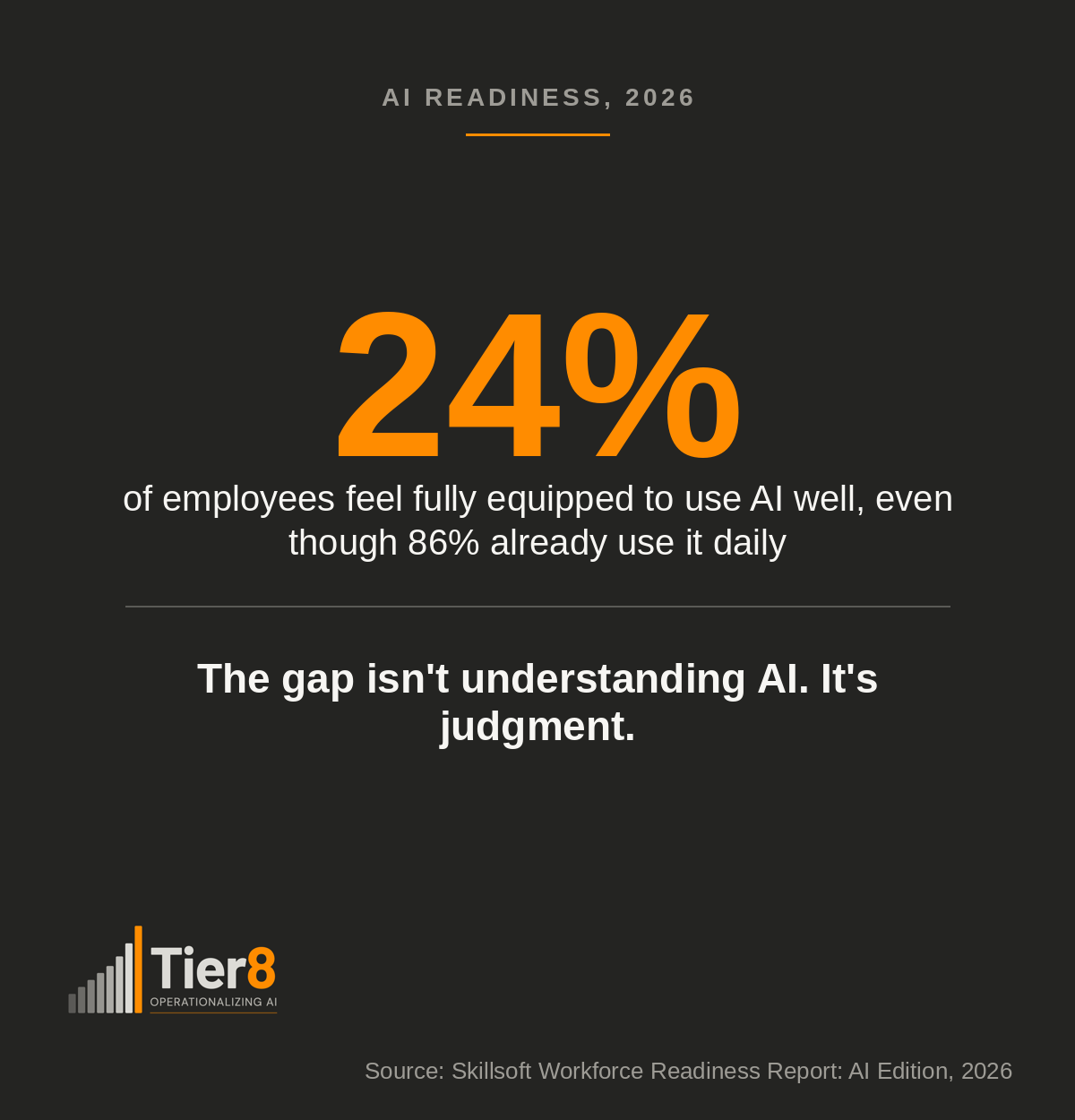
Skillsoft Workforce Readiness Report: AI Edition, 2026
Not on its own. A 2026 survey from DataCamp of 500-plus enterprise leaders across the US and UK found 59% report an AI skills gap in their organization despite 72% saying AI literacy is already a stated priority. The gap isn’t a shortage of technical content, most training programs have plenty of that. It’s a shortage of the specific, applied judgment employees actually need day to day, which a generic module explaining how large language models work doesn’t build.
What’s actually different about this training problem
I’ve been through plenty of implementations where training was a core part of the rollout, PMOs, digital automation projects, process changes across a team. But the specific judgment this article is about, knowing when to trust a result and when to check it by hand, wasn’t really a training need in most of that work. Those systems were deterministic: the same input produced the same output, every time. Once someone learned how a process behaved, it kept behaving that way. Whether people would actually adopt the new way of working was the open question in those rollouts. Whether to trust what the system gave them almost never was.
AI changes that calculation. It’s nondeterministic, the same prompt can return a different answer, sometimes a wrong one, for reasons nobody can always point to. That’s a genuinely new category of judgment for most employees, not an old skill that just needs an AI label, and it’s exactly why it deserves its own explicit training rather than getting folded into a change management plan that assumes trust was never really in question.
Where this fits into Enablement & Skills
Enablement & Skills is one of the five pillars the RAISE OS™ AI Maturity Assessment measures separately from raw usage numbers, precisely because knowing how to open a tool and knowing when to trust its output are two different capabilities. Closing the 62-point gap Skillsoft found isn’t about more technical depth. It’s about teaching the specific, narrow judgment that keeps AI use safe without requiring every employee to become an AI expert first.
Find out where your organization actually stands
See where your leadership team actually stands.
$299, 15 min/person, board-ready report
Take the assessment or explore the Transformation Roadmap →