How do we move AI from a few power users to team-wide adoption?
Every organization has a handful of AI power users and a much larger group who's barely touched it. Here's what actually closes that gap, with 2026 data on why access alone doesn't.
Every organization already has a handful of people who've quietly become excellent at using AI, and a much larger group who've barely touched it. That gap isn't a sign anything's wrong. It's the normal starting point. Moving past it takes something specific: identifying what the power users are actually doing differently, translating that into something teachable, and giving the rest of the organization a structured way to practice it, rather than hoping enthusiasm spreads on its own. It rarely does.
What the gap actually looks like in 2026
Microsoft's 2026 Work Trend Index, a survey of 20,000 knowledge workers, found 80% of self-directed AI power users report producing work they couldn't have a year ago, compared to 58% of the broader AI-using population. Power users are also more deliberate about it: 53% plan ahead of time which parts of a task need AI versus a person, compared to 33% of everyone else. The gap isn't just how often people use AI. It's how intentionally they use it.
Why enthusiasm doesn't spread on its own
Access has genuinely grown.
- Deloitte's 2026 research found the share of workers equipped with sanctioned AI tools grew from under 40% to around 60% in a single year.
- But access isn't the same as capability: only 30% of companies report actually redesigning their key processes around AI, which means most of that expanded access still depends on individuals figuring out, on their own, how to use the tool well.
A power user's habit doesn't transfer to a teammate just because the teammate has the same login.
Where I've actually watched this gap open up
I've watched this exact pattern play out in rollouts that had nothing to do with AI. A new process goes out to a large, distributed team, everyone gets the same training session, a few people take to it immediately, and most of the team quietly reverts to the old way within a few weeks. From the outside, it can look like a motivation problem, like some people cared enough to figure it out and some didn't.
It wasn't a motivation problem. Nobody translated what the fast adopters were doing into something repeatable, and nobody gave the rest of the team a real block of time to practice it instead of just being told the new process existed. The gap didn't close on its own, because nothing about the rollout was actually designed to close it. AI adoption is running into the exact same wall, just with a flashier tool behind it.
Does hiring more power users fix it?
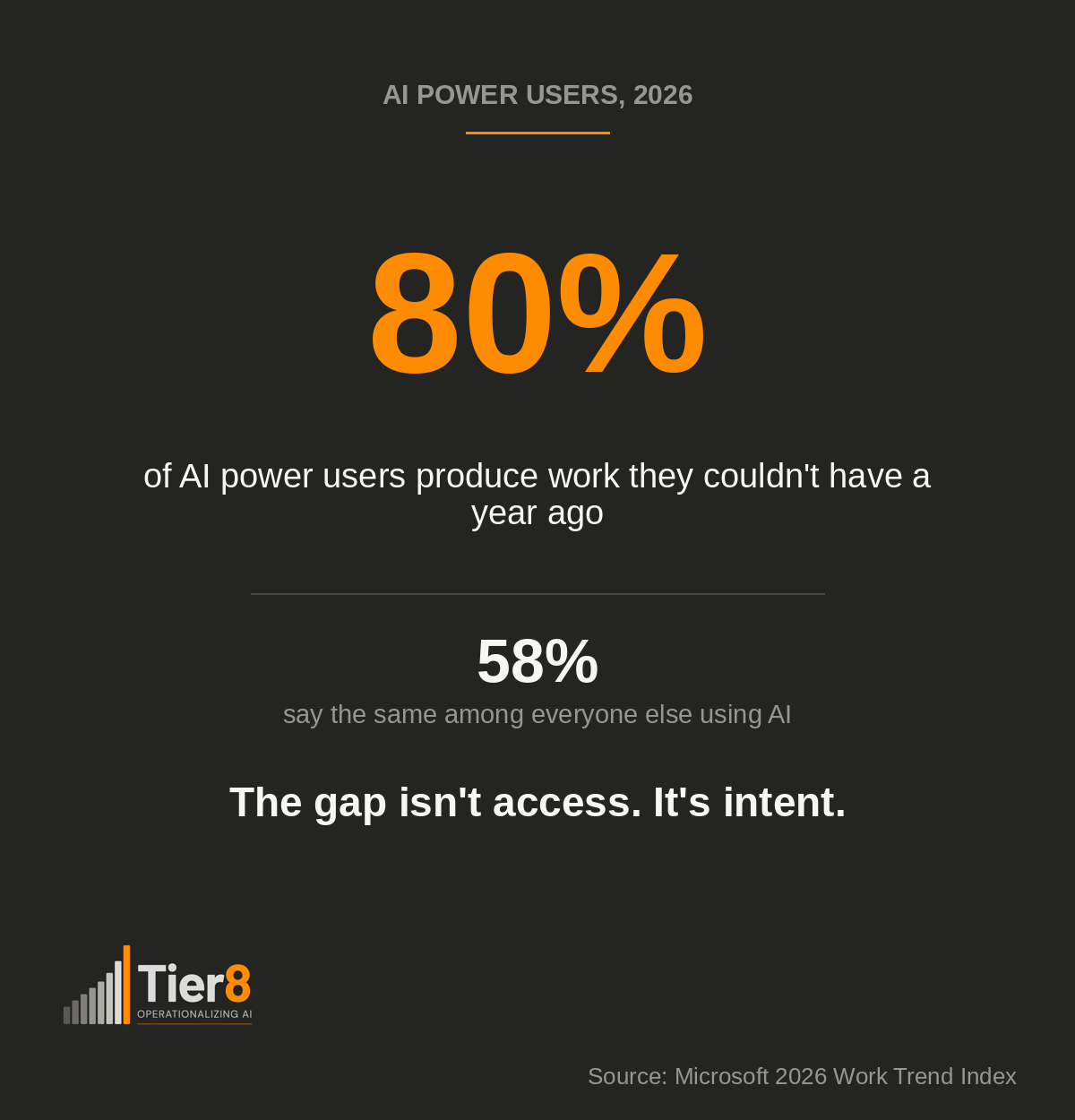
Microsoft 2026 Work Trend Index
Not by itself. A bigger group of individually excellent AI users is still a collection of individuals, not an organizational capability. If the only plan is finding and hiring more people who are naturally good at this, the gap between power users and everyone else just gets wider, since nothing changes about how the skill spreads to people already on the team. The organizations closing this gap aren't the ones with the most power users. They're the ones that turned a few people's habits into something the rest of the team could actually learn.
What actually closes the gap
- Give people a low-effort way to raise their hand. At a company with a few hundred employees, nobody knows in advance who the power users are, hunting for them one by one doesn't scale. A short, standing intake, a form or channel asking "what are you using AI for that's actually working", surfaces candidates without anyone having to go looking. It works especially well folded into the AI governance process already reviewing which tools are in use, since that process needs the same visibility anyway. A quick follow-up conversation or a side-by-side comparison of the task is what turns a raw submission into something specific enough to teach.
- Turn it into something teachable. A habit that lives in one person's head doesn't scale on its own; it has to become a repeatable example or a short workflow someone else can follow.
- Give people real time to practice, not just access. A login doesn't build a habit. A protected hour with a real task does.
- Redesign the process itself where it's worth it. The 30% of companies already doing this are the ones most likely to see AI access turn into AI capability.
A quick way to see the gap on your own team
Pick one task a power user has clearly gotten faster or better at with AI. Ask someone outside that original group to do the same task, using whatever they already know about the tool. If the results look meaningfully different, that's not a motivation problem or a talent gap. It's evidence the skill never actually left the power user's head, which is exactly what a teachable example and real practice time are meant to fix.
The real measure of team-wide adoption
The honest test isn't how many people have access to an AI tool. It's whether someone outside the original group of power users could sit down and get similar results, because the habit got taught, not just demonstrated. Integration into Work is one of the five pillars the RAISE OS™ AI Maturity Assessment measures separately from raw usage numbers, precisely because access and capability close at very different speeds.
Find out where your organization actually stands
Turn this into a sequenced transformation plan.
Founding Partner Program: five organizations, no cost
Apply for the Founding Partner Program →