What AI training actually moves the needle versus checkbox compliance training?
Checkbox AI training and training that actually changes behavior aren't the same thing. Here's the structural difference between them, and what 2026 data says about the gap.
I don't think most AI training fails because employees don't want to learn. It fails because it's built to prove a training happened, not to change how anyone actually works. There's a name for that kind of training: checkbox compliance training, a required module employees click through once, usually to satisfy a policy or an auditor, with no real connection to the tasks they do every day. Training that actually moves the needle is role-specific, hands-on, and tied to real work, and it keeps showing up after the first session instead of ending there. The gap between the two explains a lot about why skill gaps persist even at companies with high training completion rates.
Why this gap is showing up everywhere in 2026
Training completion and training effectiveness have almost stopped correlating. A 2026 survey of 1,000 employees found:
- 90% already use AI in their role
- Only 18% feel fully prepared to use it well
- Just 30% feel confident using it safely and in line with company policy
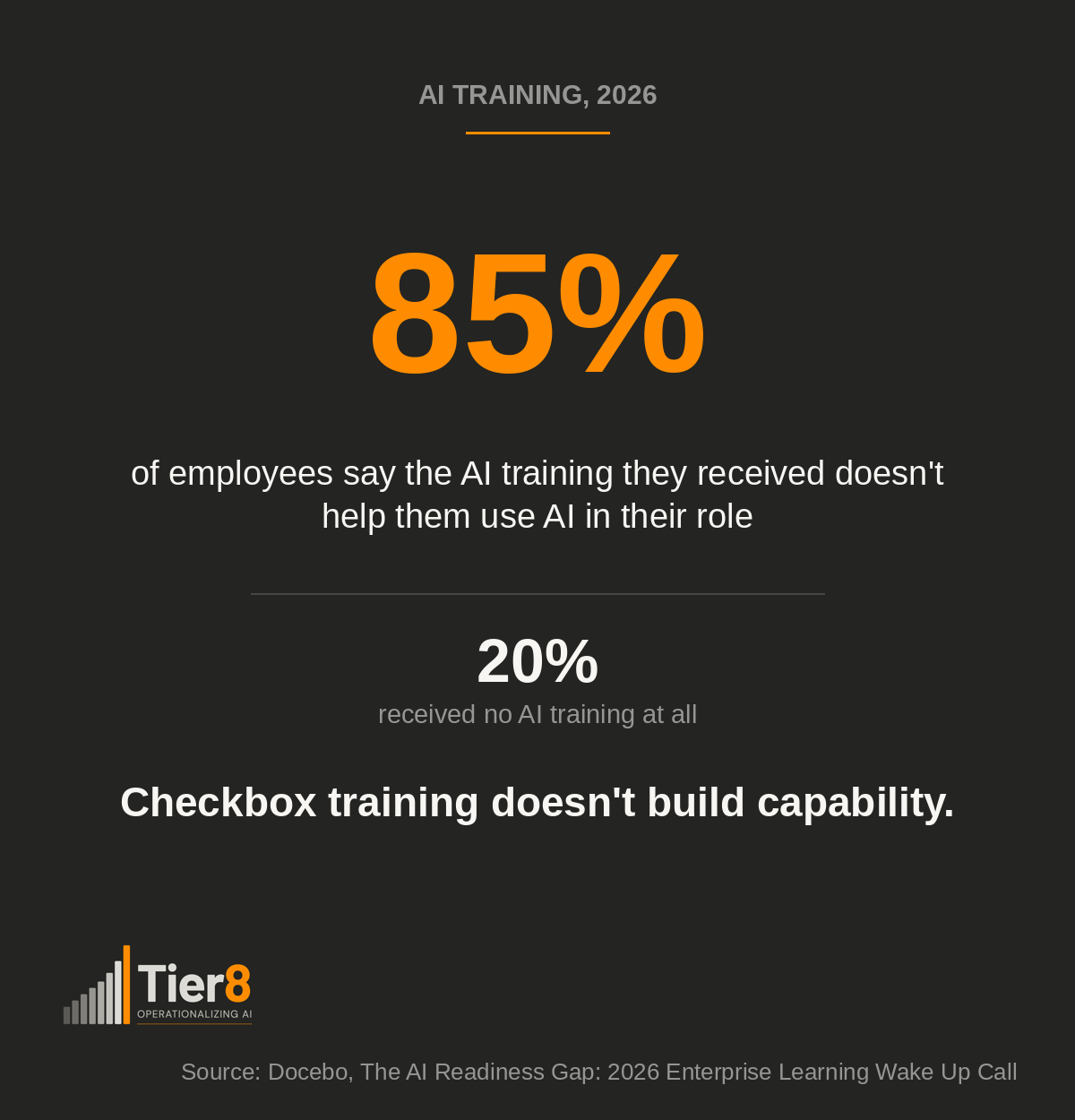
Separately, a global study of 2,000 enterprise employees found 85% say the training they received doesn't actually help them use AI in their role, even though only 20% report receiving no training at all. Training is happening. It's mostly not working.
What checkbox compliance training actually looks like
Checkbox training has a specific shape: a single required module, usually generic across every role in the company, completed once and never revisited. It tends to cover what AI is and what the policy prohibits, not how to use it well in a specific job. The 2026 employee survey found the structural gaps directly: 57% of employees say their training gave no guidance on checking AI output for accuracy, 56% got no real-world practice tasks, and 46% received no examples relevant to their actual role. The module gets marked complete. The underlying skill gap doesn't move.
Is your AI training compliance theater?
- One-time and generic. Everyone in the company gets the identical module regardless of role, and it's never repeated.
- Information without practice. Employees read or watch content about AI but never do a task with it during training.
- No guidance on judgment calls. Nothing addresses how to check AI output for accuracy or when to stop trusting it.
- Completion is the only metric tracked. Success is measured by who clicked through, not by any change in how people work.
- It ends at onboarding. Nothing revisits the training as tools, tasks, or policy change.
Any one of these can happen even in a well-intentioned program. Most of them together is a sign the training exists to satisfy a requirement, not to build a capability.
What training that actually changes behavior looks like
AI adoption isn't primarily a training problem. It's a reinforcement problem. Training gives people the basics and a chance to apply AI to a real task, but what actually determines whether it sticks is what happens after the session ends.
Picture someone who has a genuinely useful AI workshop on a Tuesday, then goes back on Wednesday to a manager who doesn't use AI, doesn't ask about it, doesn't give them time to experiment, and doesn't notice when the outcome is better. Very little of that training survives contact with that environment. Now picture the same employee with a merely average workshop, but a manager who keeps asking where AI could help, what worked, how much time it saved, and what they learned. The training quality barely matters at that point, because the environment around the person is doing the actual reinforcing.
That gap is already visible outside AI training specifically: LinkedIn's 2025 Workplace Learning Report found manager encouragement for learning has been declining, with 6% fewer employees saying their manager encouraged them to spend time learning compared to the year before. Reinforcement doesn't happen by default, it has to be built into the program on purpose.
It's also why access metrics are the wrong things to watch. Licenses, logins, training completions, and prompt counts show whether people have access to AI and whether they're experimenting with it. None of them show whether the actual work is changing, which is the only thing that matters.
The 2026 employee data found something encouraging underneath this: 54% of employees already want to improve their AI skills, and 67% say they'd only need about two hours a week to make meaningful progress. The appetite exists. What's usually missing is a program built to use it, since 25% of employees report getting no structured support from their employer at all.
Does more training hours fix it?
Docebo, The AI Readiness Gap: The 2026 Enterprise Learning Wake Up Call (research by Centiment, 2026)
Not by itself. None of this should be surprising: I don't want more generic training, and I've never met anyone who does. What actually changes behavior is training built around the job in front of you, not another general primer on AI. Leadership sees the readiness gap clearly and still underinvests in closing it: in a separate 2026 survey of business leaders, only 6% of CIOs and CTOs believed their workforce was fully ready for AI adoption, and that figure dropped to 1% among COOs. More hours of the same generic module won't close a gap leadership already knows exists. What closes it is redesigning what the training covers: role-specific tasks, explicit judgment guidance, and a cadence that continues past week one.
This isn't a new problem
In digital transformation projects I supported, the training that got treated as a checkbox, a slide deck walkthrough or a single live session, wasn't enough to get people hitting the ground running on launch day. It didn't change how people actually did their jobs. The training that stuck was different: it used the team's real work as the practice material, it was delivered by someone who could answer a judgment-call question on the spot, and it came back around a few weeks later once people had actually tried the new process and had real questions.
I learned to distrust completion rates as a success metric long before AI training became a category of its own. A 100% completion rate on a generic module tells you people opened it. It doesn't tell you whether they can do the job differently afterward. AI training is following the same pattern I've watched with other rollouts: the programs that work look almost nothing like the ones that just check a box.
How to tell if your training program is actually working
A few direct questions surface the answer faster than a completion dashboard. Could an employee explain, in their own words, how they'd check an AI output before using it in their actual job? Has anyone revisited the training since it was first delivered, or is a single session from onboarding still the entire program? If you asked five people in the same role how confident they are using AI safely and well, would you get five similar answers or five different ones?
If those answers vary widely, or if nobody can answer the first question at all, that's not a training completion problem. It's the actual measurement of whether the training worked.
Where this fits into the bigger picture
Effective training is foundational to Enablement & Skills, one of the five pillars the RAISE OS™ AI Maturity Assessment measures, and it's closely tied to Adoption & Change since skill and willingness reinforce each other. A high completion rate can be a genuinely good sign that people are engaged, but it isn't the same thing as capability, and mistaking one for the other is how training budgets get spent without closing the gap they were meant to close.
Find out where your organization actually stands
See where your leadership team actually stands.
$299, 15 min/person, board-ready report
Take the assessment or explore the Transformation Roadmap →