Do we need an approved AI tools list, and how do we actually enforce it?
An approved AI tools list only works if enforcement is built into it. Here's what actually makes one stick, with 2026 data on why most companies still can't enforce their own AI policy.
A department lead signs up for a new AI tool with a company card because it solves a real problem faster than waiting on IT’s review queue. Multiply that by every team with a deadline, and the answer to whether a company needs an approved AI tools list becomes obvious: yes. What’s less obvious is that the list itself does almost nothing on its own. A document nobody checks before adopting a new tool isn’t a control, it’s a formality. What actually determines whether shadow AI stays a manageable exception or becomes the default way tools enter the company is what happens after someone wants something that isn’t on the list yet.
The two extremes I’ve actually watched
I haven’t sat on a committee that maintained an approved vendor list, but I’ve watched both ends of this problem play out. At a company with more than 10,000 employees, getting any new system approved meant a genuinely bureaucratic process, real oversight, but slow enough that it visibly discouraged people from trying anything new.
At a company with around 200 employees, the opposite was true: anyone could adopt any tool, at any moment, with nobody checking. That flexibility felt good in the moment, but IT ended up tracking more than 200 different applications, many doing the exact same job at different price points, with no real handle on what the company was actually paying for or who had access to what.
Neither extreme worked. The large company’s process caught real problems but pushed people toward workarounds anyway. The small company had none of that friction, and paid for it in duplicate spend and untracked access instead. What actually works sits in the middle: real oversight, moving fast enough that going around it is never the easier option. That’s the same balance an approved AI tools list has to strike, on a much shorter adoption cycle than the enterprise software those two companies were dealing with.
What actually happened in 2026
IBM’s 2026 Cost of a Data Breach Report, based on 602 breached organizations across 17 industries and 16 countries, found that 43% of security incidents in the past year involved shadow AI, tools nobody had approved, more than double the share from the year before. Over two-thirds of the organizations in the study had no governance process in place to limit that kind of unapproved use at all. Unapproved tools aren’t a rare exception anymore. In a large share of companies, they’re already the majority path AI takes into the business, which makes an unenforced list less like a minor gap and more like an open door with a sign next to it nobody reads.
Why the list keeps losing to convenience
Mid-market companies aren’t dealing with one or two unofficial tools scattered around. Cledara’s 2026 platform data on companies with 30 to 500 employees found 80% already pay for at least one AI tool outright, averaging 4.1 paid AI subscriptions per company, ranging from 2 to 4 tools at the smallest companies up to 8 to 15 or more once a company reaches the 150-to-500-employee range. Every one of those tools got adopted by someone who needed it faster than an approval process could deliver. A slow list doesn’t prevent that. It just guarantees the tool arrives without anyone reviewing it first.
Four things that actually make a tools list stick
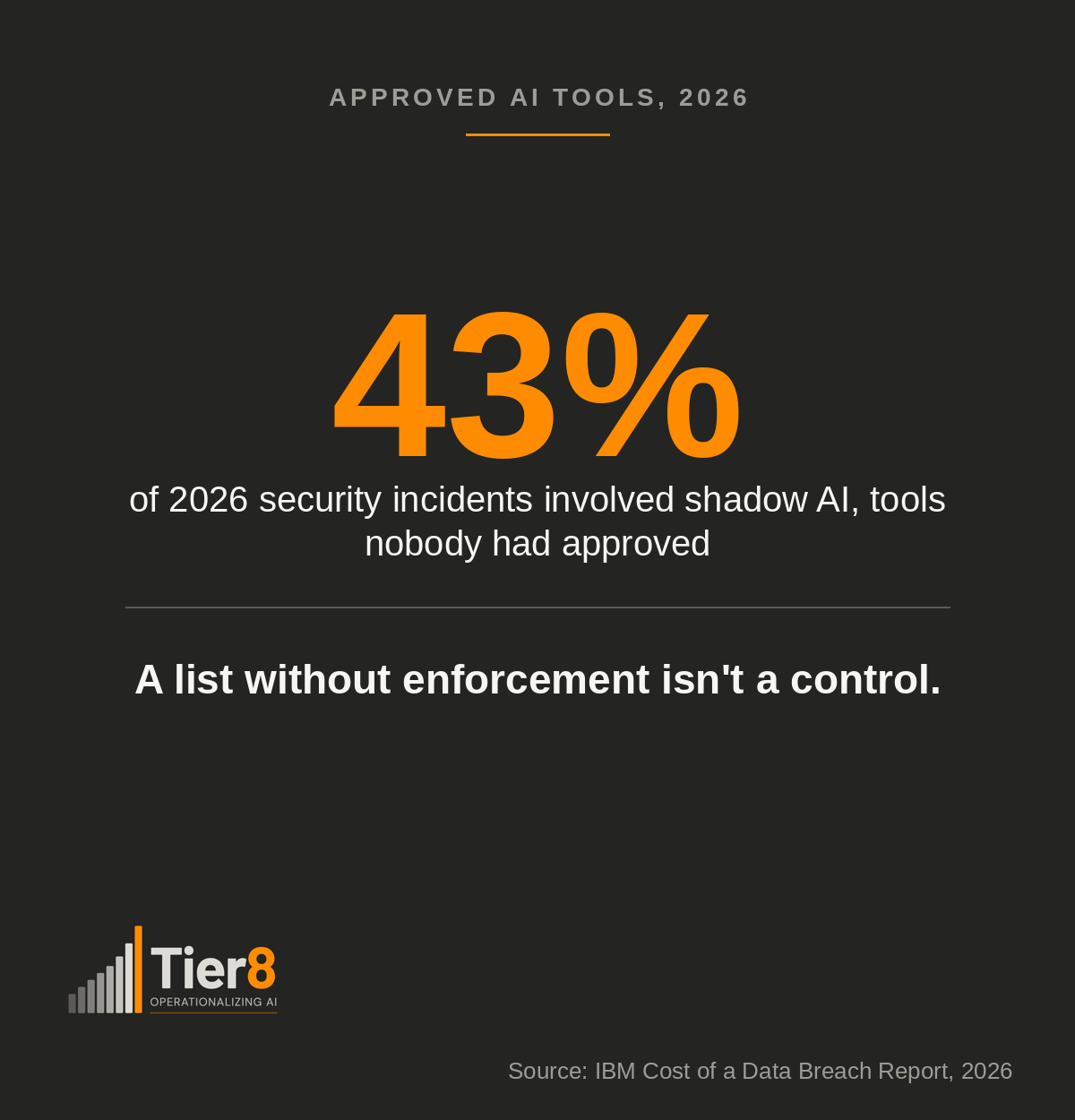
IBM Cost of a Data Breach Report, 2026
- A named owner, not a committee that meets monthly. Someone specific has to be reachable when a team wants to know if a tool is allowed, not a group whose next meeting is three weeks out.
- A fast-track review, measured in days. If the sanctioned path is slower than just signing up for the tool directly, the sanctioned path loses every time, regardless of how well-written the policy is.
- A visible, current list, not a document buried in a shared drive nobody remembers exists. It has to live somewhere people are already looking when they’re deciding whether to try something new.
- A tie-in to the existing AI governance review, rather than a separate shadow-AI process to maintain on its own. Governance and acceptable use are already two different jobs; folding tool approval into governance means one review cycle instead of two competing ones.
The real gap isn’t the list, it’s visibility
Retool’s 2026 State of AI Governance survey of 307 senior technology and security leaders found that only 5% felt very confident they had full visibility into which AI tools were actually running in production at their company, while 43% said they had no such confidence at all. A list can only govern what someone actually knows exists. Enforcement without visibility isn’t enforcement, it’s a policy nobody has the information to check.
A quick check for your own tools list
Ask three questions. Is there a specific person, not a committee, who owns approving new requests? Is that review faster than the time it takes to sign up for the tool directly, with no approval at all? And has anyone actually gone looking for AI tools already in use that never went through the process? A no to any of these means the list exists on paper, but the enforcement behind it doesn’t.
Where enforcement fits into managing AI risk
An approved AI tools list is a starting point for Security & Risk, one of the five pillars the RAISE OS™ AI Maturity Assessment measures, but it’s the visible layer of a much larger control, not the control itself. Shadow AI is already inside most mid-market companies whether a list exists or not, and it stays that way until someone owns making enforcement faster than the workaround.
Find out where your organization actually stands
See where your leadership team actually stands.
$299, 15 min/person, board-ready report
Take the assessment or explore the Transformation Roadmap →